







Modular building foundations and site prep
Modular buildings depend on more than factory precision. Their long-term performance begins on the ground, with a foundation design and site preparation plan that match the building’s size, use, and local conditions. When these early stages are handled well, installation becomes smoother, tolerances stay under control, and the finished structure performs as intended from day one.
Why foundations matter before the modules arrive
A modular building may be assembled quickly on site, but it still needs a stable base. The foundation transfers loads into the ground, keeps the structure level, and helps protect against movement caused by settlement or seasonal changes in soil moisture. If the base is inaccurate, the modules can arrive on schedule and still face alignment problems.
Load path and stability
Every modular unit has a clear load path: roof, floors, walls, and services all depend on a level, correctly engineered support. A foundation that is even slightly out of tolerance can create gaps at connections, strain finishes, and complicate service hookups. For that reason, engineers and contractors usually treat foundation design as part of the building system rather than a separate civil task.
Choosing the right foundation type
The right solution depends on ground conditions, building height, expected occupancy, and whether the structure is temporary or permanent. Common options include strip foundations, pad foundations, ground beams, slab-on-grade systems, and piled solutions. Each has advantages, but the best option is the one that matches both the module design and the site conditions.
In some projects, a straightforward slab is enough. In others, poor soil or nearby trees may call for deeper support or ground improvement. Early geotechnical advice can prevent costly redesigns later.
What site surveys should establish before work starts
A careful survey reduces surprises during installation. It informs the foundation strategy, helps the team plan access, and highlights constraints that might affect lifting operations or delivery routes. This is often where modular schemes save time: once the site is properly understood, the construction sequence can move with less interruption.
Ground conditions and drainage
Soil bearing capacity, groundwater level, contamination risk, and drainage patterns all affect the design. Poor drainage can undermine even a well-built foundation, while seasonal water movement may lead to heave or settlement. A survey should therefore look beyond surface appearance and include enough data to support engineering decisions.
Access and logistics
Modules are large, heavy, and often delivered on tight schedules. Site prep must allow for vehicles, cranes, temporary storage, and turning space. If access is limited, the delivery strategy may need staggered drop-offs, a different crane position, or temporary road hardening. These factors should be resolved early, not on the morning of installation.
How site preparation supports a smooth installation
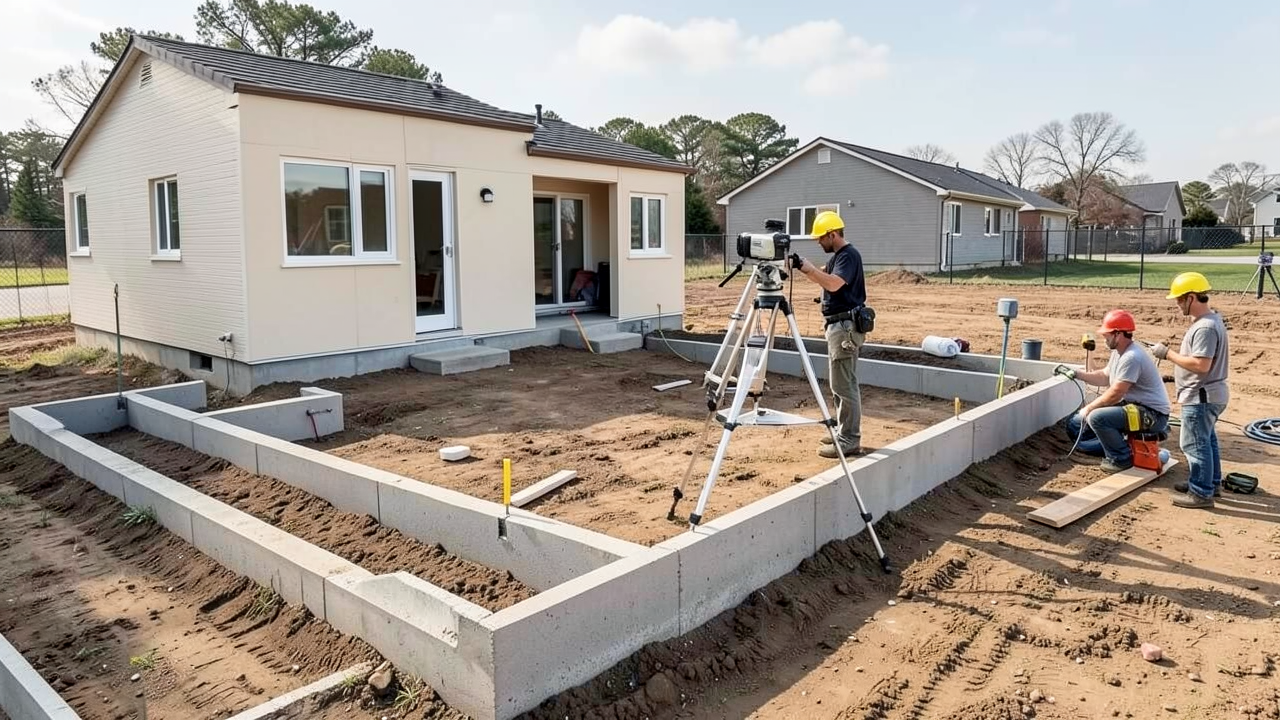
Once the design is set, the physical site prep begins. This stage usually includes clearing, excavation, setting out, utility coordination, and preparing working platforms. A neat-looking plot is not enough; the site must meet the practical demands of the installation sequence.
Clearing and setting out
Vegetation, debris, obstructions, and unstable material should be removed before any foundation work begins. Surveyors then set out the building footprint with care, since even a small positional error can affect module alignment and edge details. Tolerances should be checked repeatedly, especially where multiple units are being joined.
Excavation and formation
Excavation depths must match the foundation design and local ground conditions. Over-excavation can create unnecessary cost, while shallow formation can compromise performance. The formation level should be compacted and verified before concrete or other support elements are placed. Good records at this stage help trace any later issue back to its source.
Utilities and service routes
Modular buildings often arrive with a high degree of factory-installed services, but those services still need safe, accurate connections on site. Water, drainage, power, data, and fire systems should be coordinated with the foundation plan. Where ducts and service risers pass through or beneath the base, their positions must be fixed early to avoid clashes.
Why planning for tolerances pays off
Modular construction is efficient, but it is also unforgiving of poor dimensional control. The factory-built nature of the modules means the site base must be equally precise. Small errors can have large consequences when units are craned into place and joints need to connect first time.
Levels, plumb, and interface points
Foundation levels should be checked at multiple points, not just at corners. The interface between foundation and module base must also allow for the specified bearing and fixing method. If the site falls outside tolerance, shims, adjustments, or remedial works may be needed, which can slow down the whole programme.
Coordination with the design team
Architects, structural engineers, MEP designers, and installers should review the foundation package together. That coordination is especially useful in projects such as Modular office planning in the UK for efficient workplaces, where internal layouts, service routes, and future expansion all influence the base design. A coordinated approach reduces the risk of site changes after production has started.
Common site prep mistakes to avoid
Some problems appear repeatedly on modular projects. They are often avoidable with better planning and clearer responsibility between parties.
Underestimating ground variability
A site can look uniform while still hiding changes in bearing capacity or moisture content. If only part of the footprint is investigated, differential settlement may emerge after installation. More testing is usually cheaper than fixing movement later.
Leaving logistics too late
Delivery vehicles, cranes, and lifting teams need space and timing certainty. If the site is still being cleared when the modules are due, delays can cascade quickly. The same applies to weather-sensitive activities such as pouring concrete or preparing access roads.
Ignoring future use
A foundation should suit not just the first day of occupation but also the building’s likely life cycle. Some modular schemes are relocated, extended, or reconfigured. That is particularly relevant for education settings such as Mobile classrooms for growing schools and estates, where phased growth and changing pupil numbers can influence the base arrangement.
A practical checklist for clients and project teams
Before modules are delivered, a final review helps confirm that the site is ready. The checklist below covers the main points that usually need sign-off.
- Ground investigation has been completed and reviewed
- Foundation type matches the structural design and soil conditions
- Levels, set-out points, and tolerances have been verified
- Drainage and service routes are coordinated with the base design
- Access for deliveries, cranes, and installation teams is clear
- Weather protection and temporary works are in place where needed
- Quality checks and records have been completed before handover
Building a reliable start for the modular project
Foundation design and site preparation shape the entire modular construction process. When the ground is properly assessed, the base is built to tolerance, and logistics are planned with care, the project gains speed without sacrificing quality. That combination is one of the main reasons modular building continues to attract interest across commercial, educational, and mixed-use schemes.
For clients, the message is straightforward: treat the site as part of the building, not just the place where it stands. A well-prepared foundation is one of the strongest indicators of a successful modular project.